1. Origins and training
François Léonce Verny was born on 2 December 1837 in Aubenas, in the Ardèche, into a bourgeois family (father: Amédée Verny; mother: Thérèse Blachier). Nothing about his early life pointed to eleven years in Japan building one of the first modern arsenals in Asia.
His training was both elite and technical. He entered the École Polytechnique (class of 1856, known as X1856 in the school’s tradition), then the École d’application du génie maritime, which trained the engineers responsible for the French Navy’s shipbuilding. It was a rigorous course, heavily oriented toward naval construction and large-scale port infrastructure. He emerged from this double training with a rare command of heavy industrial works.
2. The Chinese stage: learning the terrain in Asia (1862–1864)
Before Japan, Verny cut his teeth in China. From 1862 to 1864 he was posted to Ningbo, then Shanghai, to oversee the construction of four gunboats for the Chinese imperial navy, along with a new shipyard. A technical mission, certainly, but also a diplomatic one: he simultaneously held the post of French vice-consul in Ningbo. This dual role, engineer and consular representative, would serve him well in navigating the complex relations between Western powers and Asian governments.
It was in China that he gained a direct knowledge of the Asian terrain, of port logistics, and above all of the particular dynamics of technology transfer between industrial European powers and states undergoing forced modernisation.
3. Recruitment: how France and Japan found each other
In 1864–1865, the Tokugawa shogunate, aware of its military and industrial lag behind the Western powers, sought foreign expertise to modernise its navy. On the Japanese side the project was driven by a senior official of the bakufu, Oguri Tadamasa (小栗忠順), with the support of Kurimoto Jōun (栗本鋤雲), who was close to French circles. On the French side, the counterpart was the French minister to Japan, Léon Roches. The Second Empire, which maintained sustained commercial and diplomatic relations with Japan, saw in this cooperation a way of securing influence there against the British.
Verny was recommended on the strength of his successful mission in China. At twenty-seven, he was tasked with building a modern naval arsenal from scratch in Yokosuka Bay, whose site — a natural deep-water shelter — was chosen in 1865; work began on 15 November 1865. The establishment was then called the Yokosuka seitetsujo (横須賀製鉄所), literally “the Yokosuka ironworks”, before becoming in 1871 the Yokosuka zōsenjo, the naval shipbuilding arsenal.
To recruit the team he needed, Verny travelled back to France, accompanying the Japanese diplomatic mission of Shibata Takenaka. He returned in 1866 with some forty-five people (engineers, doctors, specialised foremen and skilled workers), recruited notably from the arsenals of Brest and Toulon. They formed the core of an industrial undertaking without precedent in the Japan of the time.
A remark reported later captures Oguri’s clear-sightedness: even if the shogunate were to disappear, the arsenal would outlive it, and one could at least “sell the house with its storehouse” (dozō-tsuki uriya). History proved him right: in 1868 the shogunate collapsed, Oguri was executed by the troops of the new regime, but the Meiji government took over the arsenal and kept Verny at its head. France, for its part, had backed the losing side.
4. The work in Japan (1866–1876): building Japan’s naval modernity
The Yokosuka arsenal
Verny directed the Yokosuka arsenal until his departure in 1876. In a decade he transformed a near-untouched coastline into an operational industrial naval complex, equipped with:
- shipyards fitted out to European standards;
- stone dry docks, a technology unknown in Japan until then. The first, completed in 1871, is still in service today, within the US Navy base that occupies the former arsenal;
- mechanical workshops, foundries and forges;
- a water-supply network, carried over some seven kilometres. This “Verny water” still serves part of Yokosuka’s population today.
The Yokosuka arsenal would become one of the pillars of the Imperial Japanese Navy for decades. It was there that the Seiki (清輝) was launched in 1875, the first Japanese-built warship of the Meiji era, and later vessels such as the cruiser Hashidate, designed by another French engineer, Émile Bertin. Its role in 1904–1905 should not be overstated, however: the great battleships of the victory at Tsushima, beginning with the Mikasa, came from British yards. Yokosuka’s contribution lies elsewhere — in having given Japan the capacity to build, maintain and repair its own fleet.
Training and skills transfer
What sets Verny apart from a mere colonial entrepreneur is his explicit commitment to transferring know-how:
- He trained, depending on the source, some sixty Japanese technicians in specific industrial trades;
- He supervised a Japanese workforce numbering in the thousands;
- He founded a technical school, the Kōsha (黌舎), which trained engineers and technicians in naval construction and would outlive his departure;
- He established the principle that the Japanese should, in time, take over without foreign help.
This last point is essential: Verny’s mission was explicitly temporary. He was there to make the Japanese capable of doing without him, not to create a lasting dependency.
The lighthouses
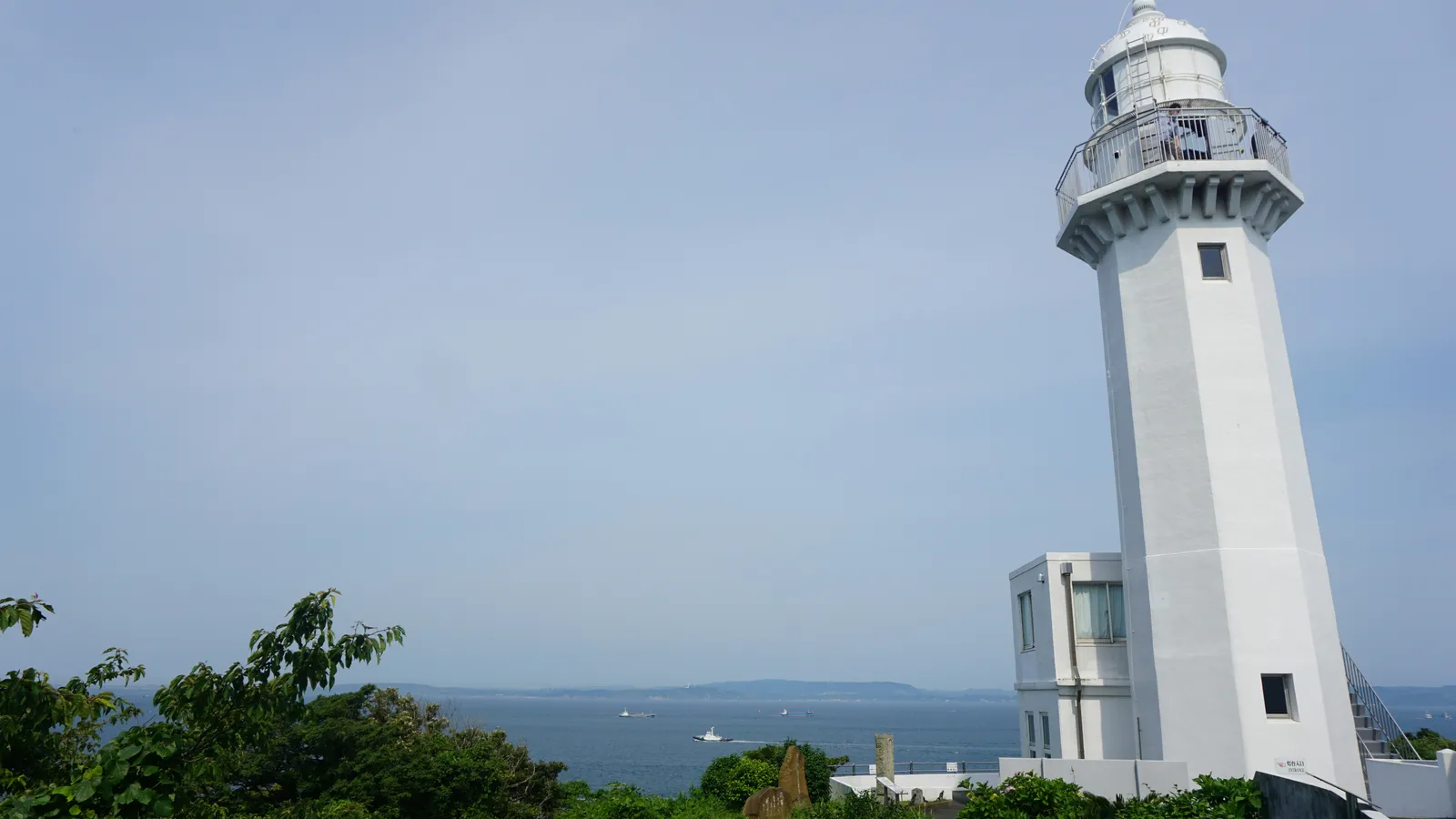
Verny was also responsible for building four lighthouses marking the entrance to Tokyo Bay: Kannonzaki, Japan’s first Western-style lighthouse, lit in 1869, then Nojimazaki, Shinagawa and Jōgashima. The Shinagawa lighthouse is preserved today at the Meiji-mura open-air museum, near Nagoya. Less spectacular than the arsenal, these structures served the same logic of modernising Japan’s sea lanes. The remainder of the lighthouse programme would be entrusted to a British engineer, Richard Henry Brunton.
The influence of the Yokosuka team in fact reached beyond the navy: it was one of its draughtsmen, Edmond Auguste Bastien, who designed the buildings of the Tomioka silk mill (1872), now a UNESCO World Heritage site.
5. Personal life in Japan
Verny’s life in Japan was not solely that of an engineer absorbed in his building sites.
In August 1867, in Shanghai, he married Elisabeth “Marie” Brenier de Montmorand, daughter of Viscount Edmond Brenier de Montmorand, plenipotentiary French consul in Shanghai, and granddaughter of General Antoine François Brenier de Montmorand. A marriage within the Franco-Asian diplomatic milieu, then.
Three of their five children were born in Yokosuka itself, which concretely anchors the family in Japanese reality:
| Name | Date of birth | Place |
|---|---|---|
| Françoise | 21 December 1870 | Yokosuka |
| Georges Marie Edmond | 1 January 1874 | Yokosuka |
| Edmée | 17 July 1875 | Yokosuka |
| Louise | 30 October 1876 | Aubenas |
| Catherine | 15 November 1879 | Firminy |
In 1869, Marie fell gravely ill, forcing Verny to take leave and be temporarily replaced at the head of the works — a telling episode of the harsh sanitary conditions faced by European expatriates in Asia at the time.
6. Return to France and later life (1876–1908)
In 1876, Verny returned to France for good. His departure coincided with the growing competence of the Japanese technicians trained on the job: the Japanese were now able to take full control of operations, a sign that the mission had achieved its aim.
The return was a disappointment. Verny, despite his exceptional experience in Asia, found no post in the French administration commensurate with his career. More precisely, the administration is thought to have deliberately withheld a post worthy of his talent, as he was suspected of having enriched himself in Japan. Verny never got over it. This disillusionment was characteristic of the fate of many French oyatoi gaikokujin (お雇い外国人, the “hired foreigners” engaged by the Japanese state) on their return: heroes of Japan’s modernisation, unknown in Paris. He resigned from state service.
From January 1877 he took charge of the Roche-la-Molière & Firminy mines (Loire), in the Saint-Étienne region, remaining until September 1895. A prestigious industrial post, but one that amounted to a step down from what he knew how to do best: he went from naval arsenals to coal mines.
He died on 2 May 1908 in Pont-d’Aubenas, in the Ardèche, not far from his birthplace. He is buried in France, not in Yokosuka as one might assume from the visibility of his monuments in Japan.
7. Why Verny is celebrated in Japan and largely unknown in France
In France, Verny is a little-known figure, familiar to Polytechnique alumni who commemorate his name, to scholars of Meiji Japan, and to the residents of Aubenas. In Japan, he is an institutionalised figure of Franco-Japanese friendship.
Several reasons explain this asymmetry.
On the Japanese side, Verny embodies something precious in the collective memory of Meiji modernisation: proof that modernisation was not a colonisation but a deliberate choice, a technical cooperation on terms negotiated by the Japanese themselves. To honour Verny is to honour Japan’s capacity to appropriate foreign technology without losing its sovereignty.
Yokosuka actively keeps Verny’s memory alive:
- Verny Park (ヴェルニー公園): a park on Yokosuka’s waterfront, facing the former arsenal, today an American naval base. It holds two busts, one of Verny and one of Oguri Tadamasa, side by side facing the bay.
- Verny Commemorative Museum (ヴェルニー記念館): a small museum within the park. Its centrepiece is a steam hammer imported from the Netherlands in 1865 for the arsenal, now designated an Important Cultural Property.
- Annual commemoration: every November, the city of Yokosuka holds the Verny–Oguri festival (ヴェルニー・小栗祭), honouring together the French engineer and the Japanese official behind the project.
On the French side, Verny fits into no celebrated national narrative. He was neither a conqueror, nor a missionary, nor a war hero. His contribution was technical and discreet, in the service of a foreign state. France has no tradition of celebrating its engineer-diplomats in Asia.
The École Polytechnique remains one of the few French institutions to keep his memory alive: he is commemorated in the alumni association’s publications (La Jaune et la Rouge), and the École’s library holds his file.